
Data Governance Assessment
Understand your current state
& take action to improve it
Strong data governance is part of Nation rebuilding and self-determination. It shapes how Nations make decisions, uphold responsibilities to citizens, and exercise authority over their own information.
Data governance is not just about systems. It includes people, processes, policies, and the cultural and legal frameworks that guide how data are collected, managed, and used.


The Data Governance Assessment provides a structured, evidence-informed starting point. Grounded in data governance frameworks developed by Indigenous governments themselves, the assessment helps Nations define their strengths, identify areas for development, and establish practical next steps aligned with their governance structures and responsibilities.
For Nations asking “Where do we start?”, the Assessment provides a clear starting point.

Why Start with an Assessment?
Many Nations recognize that data governance is foundational, yet it can be difficult to determine where to focus efforts first.
Governance structures, laws, capacities, and priorities differ across Nations, technology and evidence is evolving rapidly, and there is no single model of Indigenous data governance.
The Data Governance Assessment simplifies this complex environment by creating a standard tool based on the practical needs that Nations have for strong digital infrastructure and internal capacity. The Assessment helps Nations:
Establish a clear baseline of current data capacity
Identify priority areas for development
Inform strategic planning and funding proposals
Track progress over time
Rather than prescribing a model, the tool surfaces Nation-specific information that can support informed decision-making.


On-the-ground Impact with Okanagan Nation Alliance
With funding and support from the BC RIGC, the Okanagan Nation Alliance (ONA) was able to create a data action plan, informed by our Data Governance Assessment.
"The BC RIGC Data [Governance] Assessment tool assisted ONA in getting a through understanding on the current data needs in the organization. From that an ONA data strategy roadmap was developed and further employee and Nation engagement was sought. Most of the feedback has been positive and ONA staff feel a sense of relief that this work is done, as the need is so high."
What the Assessment Measures
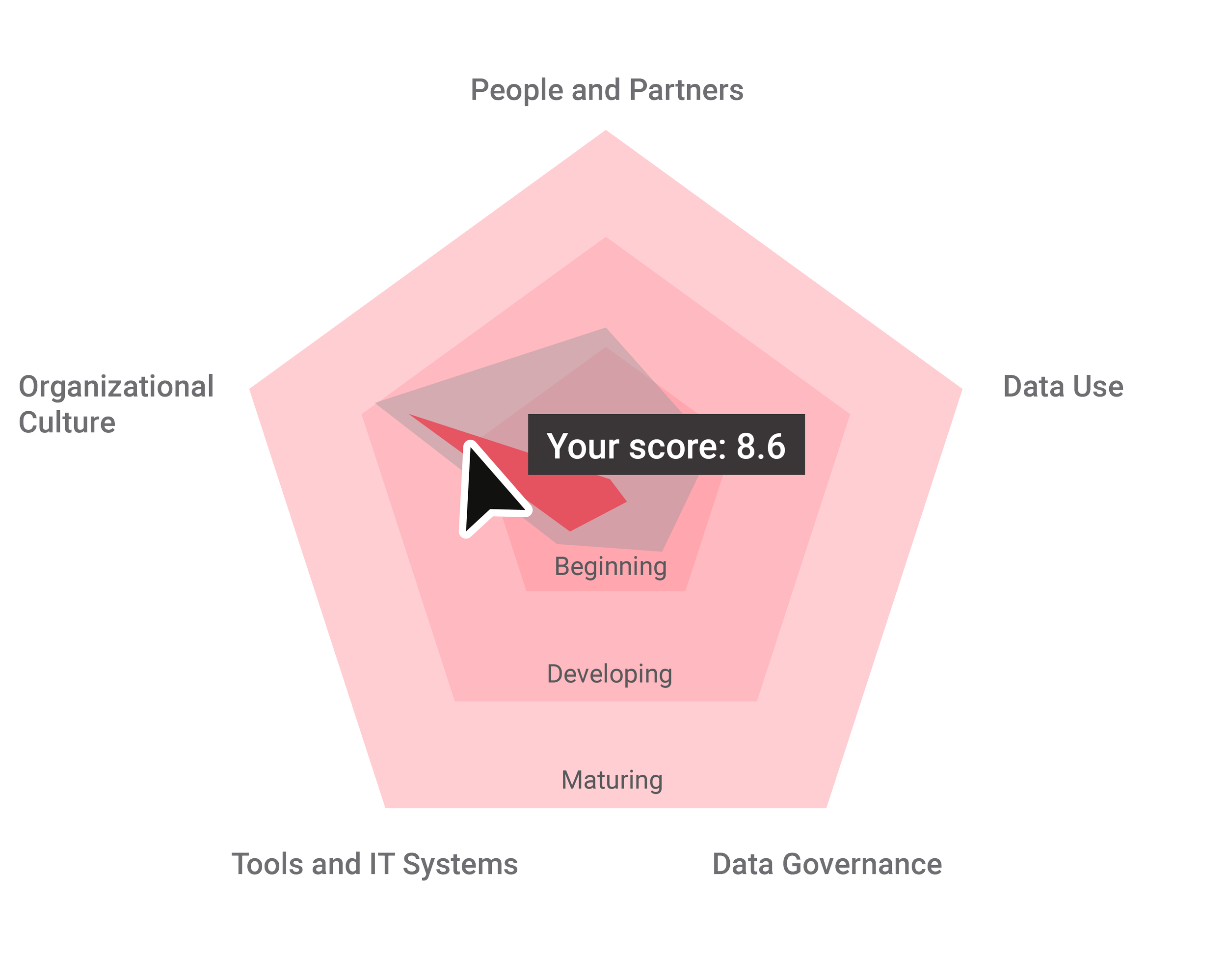
The Data Governance Assessment is grounded in the understanding that data sovereignty is exercised through systems, policies, infrastructure, and people. It examines five interrelated dimensions of data capacity:
Data Governance: the policies, structures, principles, and roles that guide how data are stewarded and protected.
Organizational Culture: the extent to which data are valued, understood, and integrated into governance processes.
People and Partners: the internal roles, responsibilities, expertise, and external relationships that support data work.
Data Use: the ability to collect, analyze, interpret, and apply data to planning and decision-making.
Tools and IT Systems: the technology and systems used to store, manage, secure, and integrate data.
Each dimension is assessed across three stages of maturity: Beginning, Developing, and Maturing. Results are generated in real time and can be revisited periodically to measure change and growth.

From Assessment to Action
The purpose of the Assessment is not simply to assign a maturity level. It is to support practical action.
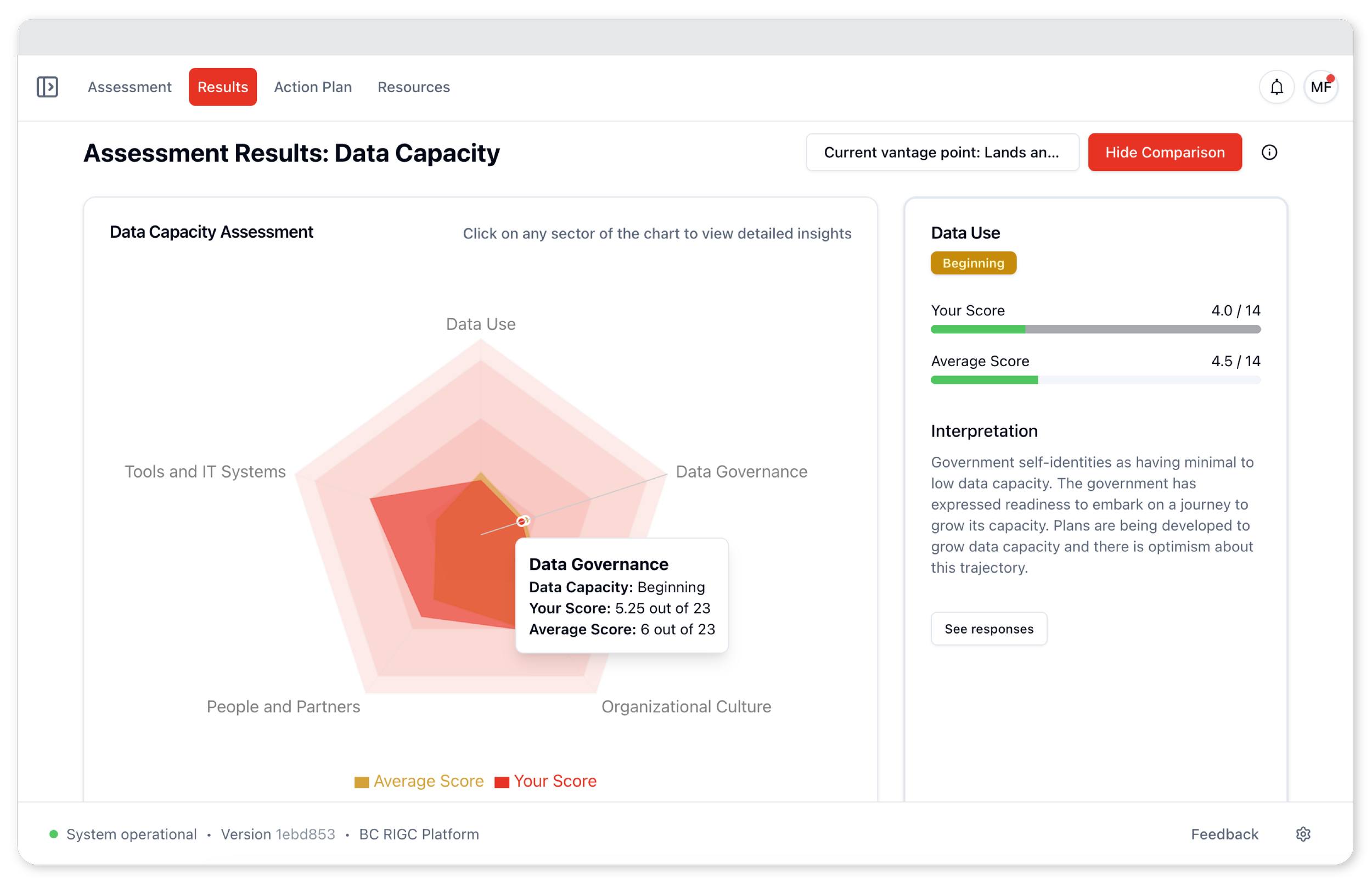
Once the Assessment is completed, users receive a summary of results and recommended priority areas. These results feed directly into the platform’s Action Planning tool, which helps Nations develop a structured plan tailored to their governance context.
The Assessment also connects Nations to relevant templates, guidance materials, and tools within the resource library, allowing Nations to move directly from assessment to implementation.
Many Nations use the Assessment as a foundation for phased infrastructure development, internal planning discussions, or funding proposals.


How the Assessment Works
The Assessment is completed online through the Build Your Own Data Centre (BYODC) and can be undertaken at an individual, departmental, or organizational level.
Users are asked to reflect on and rate their current state across the five dimensions of data capacity. One person may complete the Assessment based on consultations with colleagues, or multiple staff may participate to provide a broader organizational perspective. Results are available immediately and can be repeated over time to monitor progress.
The Assessment can be completed independently, or Nations may choose to work with the BC RIGC team for additional support throughout the process. Many Nations invite BC RIGC staff to work alongside them throughout the process, from completing the assessment to reviewing results and planning for action. This can include technical guidance, facilitation of group discussions, or collaborative interpretation of results.
Take the First Step
If your Nation is considering how to strengthen its data governance systems andbut would benefit from a clearer starting point, the Assessment provides a structured and practical way to begin.